Showing posts with label harry kellar. Show all posts

Monday, November 05, 2018

ASTONIFY at The Secret Parlor Theatre Completed

I have finished my run of shows at The Secret Parlor Theatre in Chantilly. The Secret Parlor Theatre is now gone, vanished into the night. That was the plan all along. It was an experiment  and was not planned to run more than the month.  Will the SPT ever appear again? I'd say the chances are quite good, but in a different location(s).

My final performance at the theatre was great fun. I got to share more of the light seance routine, but as with other nights, I did not do the full seance. We had a small audience and I held some things back. Also, on this night, we had ZERO actual spirit interference. What does that mean? The building we were in is haunted. Every night we were there, something unusual would happen. People heard footsteps, people felt a presence, things would not work, it was crazy. But on the final night, not a peep out of our ghost. Now, that isn't to say there weren't manifestations during the seance, because there were. But as I mentioned in the show, this was an example of Spiritualism without the aid of Spirits! By the way, that line comes from a handbill belonging to Professor Harry Cooke, which I now have in my collection, and which is part of The Astonify Show. (see below the article)

The straight magic from the show included: Hofzinser's Everywhere & Nowhere, A Surprising Rope Mystery, and a Classic Ring in Nest of Boxes. There were other pieces, but those were the main ones. The seance part of my program begins with my Spirit Photo routine, which is so much fun to do. The Spirit Dial, which is shown at the top of the page is presented during the seance portion, and it concludes with the Spirit Horn. Missing from the seance was the new slate routine, and one other routine that I'm forgetting at the moment. Because this was the smaller seance, it does not include the Spirit Cabinet.

The Astonify Show is a work in progress. I wanted it to be a smaller venue show, but it seems that it will be growing in size very quickly. I plan to  add a couple true Victorian routines to the show, and then some adaptations of modern routines. Kind of like when I steampunked some props in my other show. I'll Victorianize props, lol. to make them work in this show.  Then of course, there is another option and that is recreating actual forgotten Victorian era magic. And I have two routines in mind, the bad part, no one knows how they're done today (thus the forgotten part). One routine, The Devils Cage, is a routine I've had my heart set on for a long time. I sense it's in my very near future.

I continue to write routines for the show, so expect amazing things to debut in next years version of the show!

Saturday, March 14, 2015

Victorian Era Magicians: Harry Kellar

Heinrich Keller was born in Erie Pennsylvania on July 11, 1849. He would go on to become the most
beloved magician of his time. But in the 19th Century, how did one become a magician? Were there books on magic? Was there a course one could take? The most common approach in the 19th Century was to apprentice with a more seasoned professional. Heinrich, who went by Harry, answered an ad in the newspaper looking for a magician's apprentice. When he arrived at the home of the Fakir of Ava, he was met by a dog. The dog licked the boys hand and the gracious magician, whose real name was Isaiah Harris Hughes, invited the boy in. Almost immediately young Harry was told the job was his. When Harry asked why the magician had chosen him, Hughes told the boy that it was actually the dog who had selected Harry. All the previous young men who applied for the job caused his dog to bark and growl. But when Harry arrived, the dog greeted him like a long lost friend.

So began Harry's journey into the world of magic. He learned all he could from the Fakir of Ava and eventually attempted to go out on his own. He struggled. Show business was much harder than it looked, especially in the 1800s. Vaudeville had not yet begun. There was no TV, no internet, no radio, no true form of mass communication other than newspapers. And just to give you an idea of how long ago it was, the newspapers did not yet have the ability to print photos in their columns, only line drawings.

But Harry forged ahead, eventually teaming up with the world famous Davenport Brothers. These were two brothers who were taking the world by storm with their Spirit Cabinet effect. The Spirit Cabinet and the spiritual phenomenon that was produced altered the world of magic in many ways. Magicians recognized that the feats by so-called spirit mediums were fake, soon began to feature acts in which they exposed these feats. It was like an early public service that magicians provided to keep people from being swindled. However, not everyone chose the exposure route, some featured the Spirit Cabinet and related phenomenon and even expounded upon it.

Harry, while working as assistant to the Davenports discovered their secret. At some point Harry had gotten into an argument with one of the brothers and left their employment. But he did not go alone. William Fay left as well and in the Spring of 1873, Fay and Kellar teamed up and began to tour with a show. They struggled initially with their act, but their luck turned when they went to Cuba and then onto Mexico and South America. Fay and Kellar were a big hit suddenly and were ready to take their new found success to Europe. They booked passage on the Royal Steamship Boyne and headed to Portugal. But their luck was about to run out. The ship struck ground off the coast of France and sunk.

Aboard the ship was all the money, gold, and jewels they had accumulated during their tour, along with all of their props and costumes. All was lost. And that was also the end of the partnership between Kellar and William Fay.

But that was not the end for Harry Kellar. While in Europe Harry Kellar purchased a prop called A Vanishing Birdcage. This was the invention of French Magician Buatier DeKolta and the prop was sold to Kellar by a cousin of DeKolta's without DeKolta's permission or knowledge. Harry took the cage back to America and sold it to a magic dealer in exchange for having his entire show rebuilt. Within a few months, The Elusive Cage or Vanishing Cage as it was known, was all the rage with almost every magician in the U.S., including Harry Kellar.

In 1878, one of Kellar's main competitors died suddenly in Philadelphia, Robert Heller. In fact, it was because of Heller that Harry Kellar changed the spelling of his name from Keller to Kellar. But now that Robert Heller was gone, Harry was ready to take full advantage of the situation. He changed his promotion by using the following poem:
"For many a day,
We have heard people say
That a wondrous magician was Heller;
Change the H into K
And the E into A
And you have his superior in Kellar!"
Now Harry only had one main competitor and they would fight for the title of best magician in America for many years. Clearly, Harry was the best American born magician, but he had stiff competition with Alexander Herrmann, who actually was born in France. Herrmann the Great as he was known was a charming performer and had a very mephistopholean appearance. In fact, he has actually gone on to become the iconic image of a magician. When people draw a magician with a top hat and a mustache, they are actually drawing the image of Herrmann, whether they realize it or not.
The two rival magicians had something in common, at some point in time they both hired William Ellsworth Robinson to work behind the scenes in their shows. It was said that Robinson was the most knowledgable man in magic and both Kellar and Herrmann would take full advantage of that. Robinson would eventually go off on his own and have tremendous success in England with a very different sort of magic act.
In 1896, while on tour in the U.S. Alexander Herrmann died on board a train. The nation mourned his passing. This also meant that Kellar no longer had any serious competition for the #1 spot in the U.S. and he quickly rose to gain that title. Kellar became beloved by the American public. It is said that Harry Kellar was the inspiration for the character of the wizard in the L. Frank Baum story, The Wizard of Oz. 
As beloved as he was in America, there were a few people who felt the opposite, the Maskelyne family who were running Egyptian Hall in England. During the summer months, Kellar's show would close in America. This was due to the theatres not having air conditioning. So Kellar would go to England to try and find new material for the coming season. The greatest source of new material was at Egyptian Hall run by John Nevil Maskelyne. Kellar could work out no deal with the Maskelynes, so instead he would either find someone in England willing to recreate their illusions or he would figure it out himself and have it build in America. 

Probably the greatest item Kellar stole from Maskelyne was their levitation. John Nevil Maskelyne refused to sell the rights to the illusion so Harry did something very clever. He hired one of the acts that had worked with the Maskelyne show to come to America and work with him. Together they built a new version of the Maskelyne levitation, but they vastly improved it over what had been made before. Today it's known as the Kellar Levitation rather than the Maskelyne Levitation.


J.N. Maskeylene also created a number of automatons. The most famous of which was called Psycho. The original Psycho sat on a table with a clear tube underneath that showed their was no one concealed beneath the table nor was there anything connected to the automaton. Then the little figure would play a card game called Whist. Psycho was a remarkable figure and audiences loved it.

Kellar was able to find someone to build this automaton for him and he returned to America with his own version of Psycho. The Kellar version differed only in the facial features of the figure and the costuming. Otherwise Kellar's Psycho performed just as well. After Kellar retired, he gave Psycho to his close friend Harry Houdini. Today, the Kellar Pyscho Automaton survives in the historical collection of John Gaughan.

In May of 1908 on the stage of Ford's Theatre in Baltimore Md., Harry Kellar passed his Mantle of Magic onto his successor Howard Thurston. Kellar moved to California where he enjoyed retirement by fishing. He always kept one foot in the magic world and at one point was coaxed out of retirement by his friend Houdini for one performance in NYC.

Harry Kellar passed away in March 10, 1922. If you'd like to read more about Kellar, I've written a number of articles about him on my magic history blog at http://www.themagicdetective.com/search/label/Harry%20Kellar  Kellar was a unique person in the history of show business. Also, if you'd like to find a book on Kellar there is one available through Amazon called The Amazing Harry Kellar: Great American Magician.


Friday, February 14, 2014

Incredible Busts of Victorian Era Magicians

In the 21st Century it is rare to see a 'bust' made of someone. I think this artform began to fade when photography was invented. In the Victorian Era, busts and statues were often scene in well to do homes. Many of the greatest magicians of all time came out of this period in time. Well, a company called Spectral Motion, owned and operated by Mike and Mary Elizalde have created a series of bronze busts of 6 of magic's most famous entertainers. All of these individuals were born in the 19th Century. Please enjoy these wonderful works of art.


Jean Eugene Robert-Houdin (b.Dec 7,1805 d. June 13, 1871) Known to all of us as the Father of Modern Magic. He was the great French Conjurer who we still revere today. Inventor of many incredible automaton like Antonio Diavolo and the Fantastic Blooming Orange Bush.  Also, creator of incredible magic like the Ethereal Suspension, which in updated forms is still presented today. 

Another of his iconic creations was the Light & Heavy Chest, which was used not only to amaze and impress but also to stop a tribal uprising in French Algeria.  

A full size statue of Robert Houdin resides in front of the Maison de la Magie in Blois France.


Alexander Herrmann (b. Feb 10,1844 d. Dec 17, 1896)
The GREAT Herrmann is considered by many to be the first in the line of the famed Mantle of Magic. He was also a Frenchman, like Houdin, but made his fame here in America. Originally, he worked with his brother Compars, until he went out on his own. Compars Herrmann was equally as famous in Europe as his younger brother was in America. The Herrmann's had a Mephistopholean appearance that added to their mystery and intrigue.

Though he had a very mysterious appearance, his magic and performance was filled with comedy. He was also known to do magic off-stage in public places. Perhaps we should credit Alexander Herrmann with being the creator of 'Street Magic'!

Herrmann died suddenly on a train in 1896. His wife Adelaide took over the show and was joined by her nephew Leon, who also bore a striking resemblance to Alexander.


Harry Kellar (b. July 11, 1849 d. March 10,1922) Here we have the Dean of Magicians. So called, because he was the first 'Dean' of the Society of American Magicians. Harry Kellar was the first nationally famous American born magician. The second in line for the Mantle of Magic, though technically, it really started with him, though some do put Herrmann first.

Kellar began his career as an apprentice to the Fakir of Ava. He went out on his own for a short time and eventually went to work for the Davenport Brothers. When he had a falling out with one of the brothers, he left them and took another employee, William Fay, with him. They toured North and South America and were heading to Europe when a ship wreck ended their tour.

Kellar found his way back to the U.S. and rebuilt his show and went on to  have a flourishing career. He and Herrmann, though not friends, shared a secret that I will reveal a bit later in this article.


HOUDINI (b March 24,1874 d. Oct 31, 1926) The most famous magician in the world, who wanted to be known as an 'escape artist' for much of his life, and then as an actor, producer and later as an author and scientific investigator. Eventually, he would return to magic in a grand way with his Three In One Show of Magic, Escapes and Spiritualist Exposures. Houdini is likely responsible for inspiring more people into magic than anyone alive. I know my own push into magic came from discovering Houdini. 

The creation of the Magic Detective Blog, really has a lot to do with Houdini. There are 172 articles on the blog that are either about or that refer to Harry. The next closest is Harry Kellar with 32. He is an icon, a legend and the bust of Houdini created by Spectral Motion captures Houdini in all his splendor. He looks confident, proud and defiant. It's a fantastic image of the Master Mystifier.

Howard Thurston (b. July 20, 1869 d. April 13, 1936) 
If we talk of the Mantle of Magic, Howard received the Mantle of Magic from Harry Kellar in a ceremony at Ford's Theatre in Baltimore on May 16th, 1908. In all truth, it had more to do with Kellar selling his show to Thurston, but it sure made a great publicity campaign and a tradition that has continued up until present time.

I always thought Thurston was a great performer. But I never quite knew the whole story until Jim Steinmeyer published an incredible biography on Thurston called, The Last Greatest Magician In The World. It is a must read for anyone interested in magic or magic history.

Thurston had been making plans to pass the Mantle of Magic onto one of his associates, Harry Jansen, known professionally as Dante. There was never an official ceremony however because Thurston died suddenly.


Chung Ling Soo (b. April 2, 1861 d. March 23, 1918) 
I must admit when I first looked over the list
of people who were selected for bronzes, the one odd one was Chung Ling Soo, at least to me. He was born William Ellsworth Robinson and in all truth, his inclusion in this list is well deserved. Robinson worked for Alexander Herrmann. Later, he worked for Harry Kellar. Robinson was the 'secret' that I referred to earlier. He worked for the rival magicians before his own rise to fame. He was known as the most knowledgeable man in magic during his time. He played an important part in the success of both. 

Robinson also has a connection to Thurston. He allowed Thurston to show Leon Herrmann his version of the Rising Cards, and when it amazed Herrmann, Thurston publicized himself as 'The Man Who Fooled Herrmann'. The meeting would never have happened without Robinson however.

When Robinson went out on his own, he failed miserably. It wasn't until he came up with the idea of doing an Chinese after seeing Ching Ling Foo, that things really took off for him. So convincing was he in his performance that the public was unaware that Soo was really an American. They truly bought into the idea that he was Chinese. He even used an interpreter when he gave interviews. He is the only real life magician who gets a spot in the movie 'The Prestige'. He also had one of the most tragic deaths in the history of magic having been killed while performing the dangerous Bullet Catching Feat.

All of these busts are a little over 12 inches tall. They are made of bronze and are available for purchase. They were produced in limited quantities of 40, so there isn't a huge supply, but there are some that remain. They are all on display at the Magic Castle if you are interested in seeing them in person. If you want to purchase one of these wonderful works of art, realize you are not buying a mass produced bust from Target or Walmart. These are museum quality and exceptional pieces. If you are interested in purchasing one, and I really encourage you to consider this investment because once they are gone, they will be gone for good. Below is the flyer which has all the information for purchasing. You can reach them at (818)956-6080 or by email at orders@spectralmotion.com

Special thanks for Mike and Mary Elizalde for providing all the wonderful photographs and for your great contribution to magic. 

*This article also appears on my MagicDetective Blog.


Friday, September 13, 2013

Magic Posters with a Steampunk Feel

As I get more involved in the world of Steampunk, I've found one particular thing kind of funny, or actually ironic. Many people involved in steampunk had almost an instinctive interest in this genre without ever knowing it had a name. I suppose for me it should come as no surprise. I've been surrounded by items related to the Victorian era for ages. But I still recall the first time I made what would now be considered a 'steampunk' drawing (for the record it was the late 1980s). The drawing was an idea for a cool design on a magic prop, but I had no idea about the world of steampunk at the time. So my interest in steampunk stuff began long ago. If you're wondering what these Victorian era things are that I'm surrounded by, they are magic posters.

I thought I'd share a couple magic posters with you that to me have a decidedly steampunk feel to
them. The first is of David Devant the great British Magician and one time partner of John Nevil Maskelyne. The poster was actually painted by a famous artist of the time whose name escapes me. Devant had several posters created by the same artist. This one with the goggles strikes me as the most 'steampunk' of the bunch!

David Devant was the most popular English magician of his day and frankly throughout most of the 20th Century. He was also a genius. He saw the Lumiere Brothers invention called The Cinematograph and recognized the importance and potential for popularity of this machine. Though he was unable to obtain a projector from the Lumiere Brothers, he did find someone who could build one for him and he was soon showing movies at the Egyptian Hall Theatre. There is actually film footage that exists of David Devant from that time. The footage is brief, only 32 seconds but captures a joyful Devant pretending to do magic but actually relying upon camera tricks.

The next poster belongs to The Great Herrmann, Alexander Herrmann. One of the wonderful aspects popular in the Victorian Era and thus popular with steampunkers is facial hair. This poster captures that quality quite well.

Alexander Herrmann was from a family of magicians. His father Samuel and older brother Compars were both magicians. In fact, Compars was extremely popular all over Europe and according to legend, kidnapped his younger brother Alexander to make him part of his show.

When Compars decided to leave America and return to Europe, Alexander stayed behind and eventually became the pre-eminent magician in the US.  Alexander would die on a train while on tour in 1896. His wife Adelaide took over the show and along with her nephew Leon Herrmann, began to tour again. She and Leon did not stay together long and they eventually went their separate ways. Last year, Adelaide Herrmann's memoirs were located and published and they are an exciting record of performing in the Victorian Age.


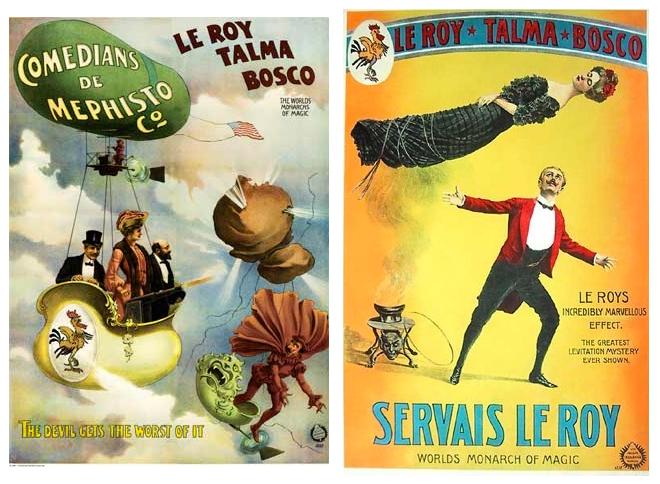
Now, some of the best posters for the Victorian flare have to come from Servais LeRoy. These are his troupe, LeRoy-Talma-Bosco, known as the Monarchs of Magic. They have it all, crazy mustaches, tuxedos, great gowns, hot air balloons and just the overall steampunk feel. Servais LeRoy was a genius when it came to magic. Many of his effects are still performed today, though I doubt many remember that he was the creator. The last years of his life were rather tragic unfortunately. You can read about it here.


Our final set of posters come from another iconic magic figure from the Golden Age of Magic. He was Harry Kellar and he assumed the role as #1 Magician in America after Herrmann died. He was actually first nationally famous magician who was American born. So popular was Harry Kellar that it is said he was the inspiration for the character of the Wizard in L.Frank Baum's novel The Wizard of Oz.

Harry Kellar became famous for his posters with pictures of the Devil or devilish imps. Though he was not the first to use this imagery. His predecessors Robert Heller and Alexander Herrmann both used devils in their advertising. In fact, Robert Heller was known to promote his appearances with the slogan, 'Go To Hell-ers'. Harry Kellar had a long prosperous career and then sold his show to up and comer Howard Thurston who continued the tradition of the big traveling illusion show for many years.

I have written about all of the above performers on my magic history blog TheMagicDetective.com so if you're interested, go over there and take a look.